If your pool filter is leaking, shut the pump off at the breaker, open the air relief valve, and look at where the water is coming from. Most filter leaks start at a seal, such as a clamp O-ring, a union fitting, a drain plug or the pressure gauge. A crack in the tank body is the exception, and it means the filter needs replacing. A leak at the clamp or lid of a pressurized filter is also a safety matter, so it deserves more care than a dripping hose. This guide helps Port Charlotte, Sarasota, Venice and North Port homeowners work out what they are looking at, what is reasonable to check themselves, and when to call us.
TL;DR
- Turn off the pump and power first. Never tighten a leaking clamp while the system is running, because the tank is under pressure.
- Leaks usually come from six places: the multiport valve O-ring, union fittings, drain plug, pressure gauge, backwash port or the tank body. Failed O-rings and gaskets are the most common cause.
- A cracked tank body generally means replacement, not a patch.
- Hayward filters call for genuine Hayward parts and a torque wrench at the clamp, not hand-tightening.
- If the leak returns after a reseal, or the tank looks damaged, book a technician rather than reassemble it again.
Safety First: Depressurize Before You Touch Anything
A pool filter is a sealed tank that holds water under pressure whenever the pump runs. That is why a small weep at the clamp is more serious than the same drip at a hose bib.
Hayward’s instructions are clear on the sequence. Before touching the clamp, shut off all pumps and electrical power, open the manual air relief valve, and confirm the pressure gauge reads zero. The same document warns that tightening a clamp under load can cause sudden, explosive component separation and severe injury.
Two habits to drop right away:
- Do not tighten a leaking clamp while the pump is running, even a quarter turn.
- Do not strike the clamp with a hammer or other metal tool to seat it.
If the gauge will not drop to zero, or you cannot tell whether the pump is truly off, stop and call a professional. Our technicians handle this every week in Southwest Florida, and it is a short visit compared with an injury.
Where Pool Filters Leak: Six Common Points
The first job is to find out where the water starts. Wipe the filter dry with a towel, restart the system briefly (standing clear of the tank), and watch which spot darkens first. Water often runs down the tank and pools at the base, so the lowest wet spot is rarely the source.
The guide at Pool Filter Guide groups leaks into six locations. Here is how they play out in practice.
| Leak Location | Likely Cause | Typical Outcome |
|---|---|---|
| Clamp or tank seam | Worn, pinched or dirty O-ring or seal | Reseal with a new or cleaned seal |
| Multiport valve (sand filters) | Valve O-ring or gasket failure | Replace the O-ring or gasket |
| Union fittings | Loose or worn union O-ring | Reseat or replace the O-ring |
| Drain plug | Missing or worn gasket | Replace the gasket or plug |
| Pressure gauge | Failed threads or gauge seal | Replace the gauge |
| Tank body | Crack from age, UV or pressure | Replace the filter |
The same source notes that O-ring and gasket failures are the most common and often cost under $20 in parts. That is the parts price only. The real cost of a seal repair is getting it diagnosed correctly and reassembled so it holds.
If you want a plain-language look at how plumbers think about finding the source of a leak before replacing parts, the logic carries over: confirm the origin first, then fix only that.
Leaks at the Clamp, Band or Lid
This is the most searched version of the problem, and the one most often caused by a recent cleaning. A leak at the tank seam right after you opened the filter is almost always a seal or closure problem, not a failed tank.
Common reasons include:
- A seal that is dirty, twisted, pinched or not seated in its groove
- A seal that has dried out, stretched or flattened after years of use
- An internal component, such as a cartridge or manifold, sitting slightly off, so the lid cannot close flush
- A clamp that was hand-tightened rather than torqued
Leaks at Unions, Drain Plug and Gauge
These are usually the simplest leaks. A union O-ring that has hardened will weep at the pump or filter connection. A drain plug without its gasket will drip steadily at the bottom of the tank. A gauge that sprays or drips from its threads should be replaced, not wrapped in tape. If the gauge reads zero while the pump is running, the gauge may have failed, or the system may have lost prime, which calls for professional diagnosis.
Leaks From the Tank Body
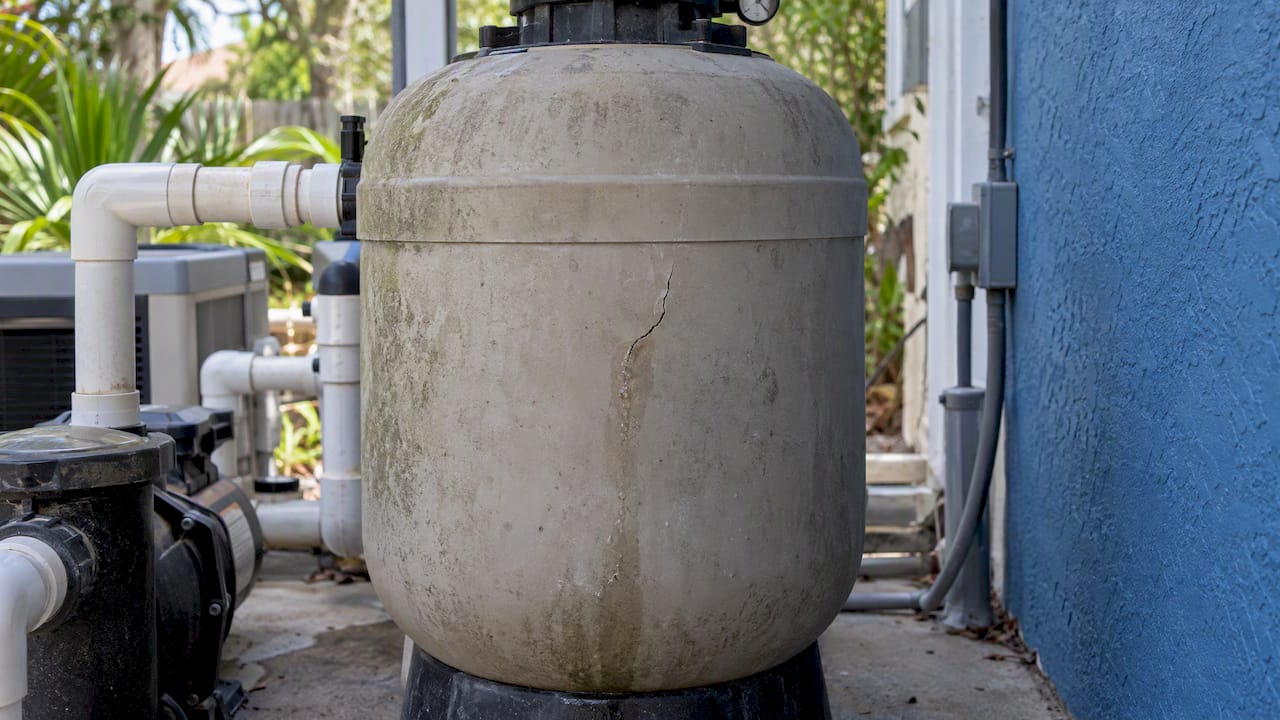
If water is seeping through the tank wall itself, or you see a hairline crack, the repair is a new filter. Epoxy patches are typically ineffective under operating pressure, and a tank that fails under pressure is a hazard. Tank age matters here: sand filter tanks generally last 15 to 25 years, and cartridge filter tanks 10 to 15 years, according to Pool Filter Guide. Florida sun is hard on plastic and fiberglass, so older tanks on exposed equipment pads deserve a close look. We cover the climate side in our guide to Florida pool equipment lifespan.
How to Reseal a Leaking Clamp the Right Way
If you are comfortable working on your own equipment and the tank is intact, these steps follow the manufacturer’s guidance for Hayward clamp systems. If your filter is another brand, check its manual, because torque values and lubrication rules differ.
- Power down. Switch off the pump at the breaker and any automation that could start it.
- Release pressure. Open the manual air relief valve and confirm the gauge reads zero.
- Remove the clamp and lid. Lift the lid carefully and set it aside without dropping it on the seal surface.
- Clean everything the seal touches. Rinse the O-ring, its groove and the tank lip with clean water. Hayward’s guidance points out that a single grain of sand or speck of DE powder on the sealing surface can cause the leak.
- Inspect the seal. Look for flat spots, nicks, cracks or stretching. If in doubt, replace it.
- Check internal parts. Make sure the cartridge or manifold is seated correctly.
- Close and clamp. Seat the lid flush, then tighten the clamp nuts with a torque wrench.
Seal Rules That Surprise People
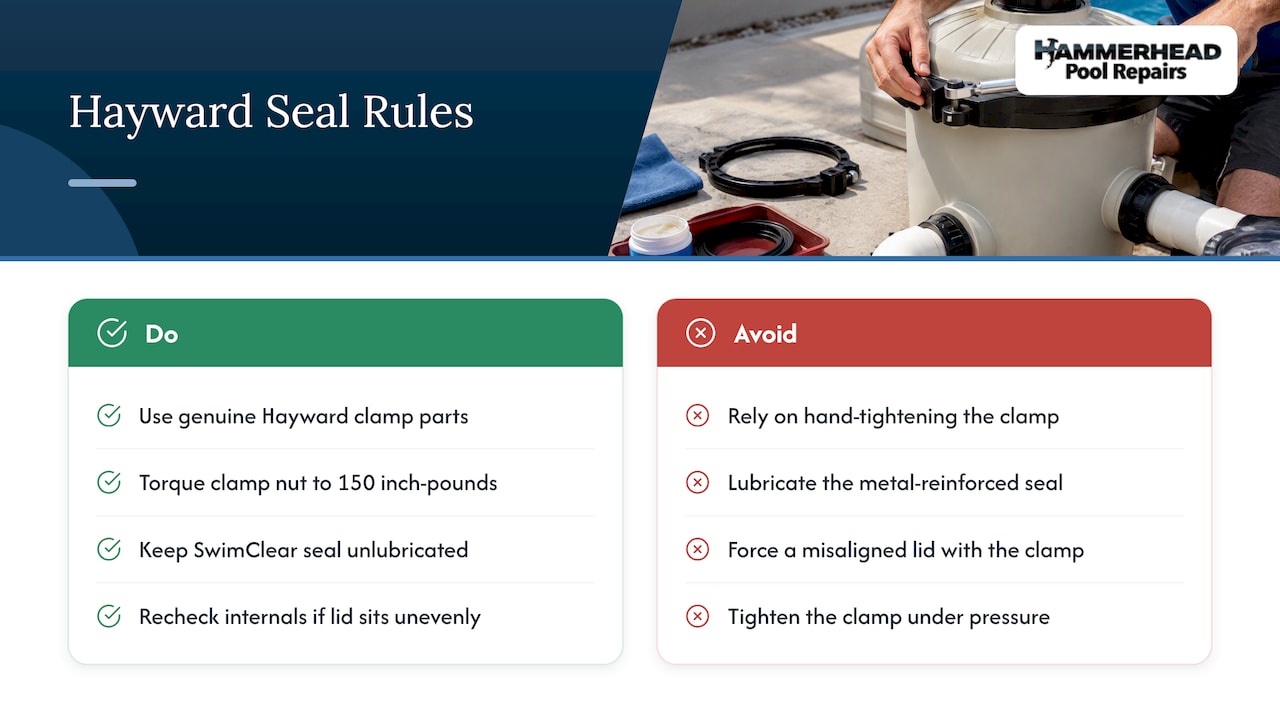
For Hayward clamp leaks, the manufacturer specifies genuine parts, including the DEX2421JKIT clamp system and the DEX2422Z2 metal-reinforced seal, and a clamp nut torque of 150 inch-pounds. Hand-tightening is not enough for a pressurized system. Non-genuine components or incorrect torque can lead to component separation.
On Hayward SwimClear cartridge filters, the metal-reinforced seal should not be lubricated. Pool grease can let it slip out of position as the clamp tightens, which causes a new leak. Many people reach for lubricant out of habit, so this is worth knowing before you reassemble.
If the lid will not sit flush after cleaning, do not force it down with the clamp. That usually means an internal part is misaligned, and forcing it can crack the filter body or fail the seal right away. Lift the lid, recheck the internals and try again.
When the system is back together, restart the pump, stay clear of the tank, and watch the seam for several minutes. Check again after the pool has run a full cycle, since a slow seep can take time to show.
Why a DIY Reseal Fails Within Days
The most common reason is rushing the cleaning step. Debris on the seal or in the groove, or a seal that is not aligned before the tank closes, is why many do-it-yourself attempts fail soon after. A second reason is mixing parts: an aftermarket seal that is slightly the wrong profile will not compress evenly, even if it looks identical. A third is overtightening to compensate for a seal that was never seated, which can distort the clamp or crack the lid.
If you have resealed once and the leak is back, stop. Repeated opening and closing wears the seal, and the cause is probably something else: a warped lid, a damaged groove or a cracked tank.
Leak, Air Bubbles or Pressure Problems? Related Signs
A leak is sometimes one symptom of a bigger circulation problem. Look at the whole system before you decide.
- Air bubbles at the returns. Low filter pressure with bubbles can point to an air leak on the suction side, such as a faulty pump lid O-ring or a clogged skimmer basket, as INYO Pools explains. We walk through causes in our guide to air bubbles coming out of pool returns and air bubbles in the pool pump.
- High pressure before the leak started. A filter that was overpressurized with debris stresses the seals. Pool owners typically clean or backwash when the gauge climbs roughly 8 to 10 PSI above the clean starting pressure. See our high filter pressure guide for Southwest Florida causes.
- Water at the pump, not the filter. Many leaks blamed on the filter come from the pump lid, shaft seal or unions beside it. Our article on a leaking pool pump shows how to tell them apart.
- Wet ground along the pipes. If the filter is dry but the ground near the pad is wet, the problem may be plumbing. Read about a pool return line leak before assuming the filter is at fault.
- Cloudy water after a leak. Low water or a failing filter can leave the pool cloudy. See pool filter problems and cloudy water.
Why Filter Seals Fail Faster in Southwest Florida
Florida pool equipment works almost year-round. There is no winter shutdown for most of our customers in Port Charlotte, Punta Gorda, Englewood and Sarasota, so seals and gaskets run through heat, sun and constant pressure cycling without a rest. That is our own field observation as a repair company, and it matches the broader point that plastic components start breaking down around the three to five year mark.
Water chemistry plays a role too. Low pH, below 7.2, is a primary accelerant for corrosion in heaters and internal filter components, and stable chemistry plus regular inspection of O-rings, seals and filter media is the best way to avoid early failure, according to the same Xylem article. Our piece on the three Cs of pool maintenance covers the basics.
A few simple habits help:
- Inspect the clamp seal and unions each time you open the filter.
- Keep spare O-rings that match your model on hand.
- Replace cartridge elements and sand on schedule. Cartridge elements typically last 1 to 3 years, and sand media typically needs replacing every 5 to 7 years, per Pool Filter Guide.
- Check the equipment pad after heavy rain and storms for loose fittings and standing water.
Our Perspective: Why We Treat Filter Leaks Carefully
We are an authorized Hayward dealer, and our technicians are trained specifically on Hayward products. That shapes how we handle a leaking filter.
First, we diagnose before we replace. A wet filter is not always a bad filter, and a seal that costs a few dollars should not turn into a new tank. Second, we use genuine Hayward parts, because the manufacturer specifies them for the clamp system and seal and warns against non-genuine components. Third, we reassemble to the manufacturer’s torque specification rather than by feel.
When the tank is cracked or the lid is damaged, we say so plainly and explain the replacement options, including whether it makes sense to repair or replace the surrounding equipment. Our repair versus replacement guide for Florida explains how we weigh that decision.
We would rather you call us before a leak turns into a burst than after.
— Hammerhead Pool Repairs
When to Call a Pool Technician
Call us instead of reassembling the filter yourself if any of these apply:
- The pressure gauge will not drop to zero after you shut the system off.
- The tank has a visible crack, warped lid or damaged clamp.
- The leak returned after you replaced the seal.
- You cannot identify the source, or water is coming from several places.
- The filter is not a Hayward and you do not have its manual.
- You manage a rental or commercial property and need the pool back in service quickly.
If you are comparing the cost of repair with a new filter, a technician can tell you what the leak is before you spend anything on parts.
Book Pool Filter Repair in Southwest Florida
Our pool filter repair service covers diagnostics, seal and clamp repairs, and filter replacement across Port Charlotte, Punta Gorda, Englewood, North Port, Sarasota, Siesta Key, Venice and Boca Grande. If the leak is part of a wider issue, our pool equipment repair team also handles pumps, heaters, plumbing, salt systems and automation. We also offer $50 off all pool equipment repairs, so check the terms on that page when you book.
Pool Filter Leak Questions Answered
Why Is My Pool Filter Leaking at the Clamp?
The usual cause is a seal that is dirty, worn, pinched or out of its groove, especially after the filter was opened for cleaning. An internal part that sits off center can also stop the lid from closing flush. Depressurize the system first, then clean and inspect the seal.
Can I Tighten the Clamp While the Pump Is Running?
No. Hayward warns that adjusting a clamp under pressure can cause violent component separation. Shut off the power, open the air relief valve and confirm the gauge reads zero first.
Can a Cracked Pool Filter Tank Be Repaired?
Generally not. Epoxy patches are typically ineffective under operating pressure, so a cracked tank body usually means a new filter. A technician can confirm the damage and help you choose the replacement.
How Long Does a Pool Filter Last?
Sand filter tanks generally last 15 to 25 years and cartridge filter tanks 10 to 15 years, per Pool Filter Guide. Heat, sun and water chemistry can shorten that in Florida.
Is a Leaking Pool Filter an Emergency?
Treat a spray or steady stream as one: turn the pump off and call a technician. A slow drip at a union or drain plug is less urgent, but it can worsen and let the pump run dry or air enter the system, so do not leave it for weeks.
Sources Behind This Guide
- Why Is My Pool Filter Leaking? 6 Causes and Fixes, Pool Filter Guide
- Hayward SwimClear Filter Owner’s Guide (ISC2030)
- Pool Filter Troubleshooting, INYO Pools
- Understanding the Lifecycle of Your Pool’s Equipment, Xylem
- Pool Filter Leaking Around the Lid or Clamp, Terra Hills